

The basics
Transgender (adjective), commonly abbreviated as trans: Describing a person whose gender identity differs from the sex they were assigned at birth.
It is sometimes simplified as ‘a woman trapped in a man’s body’ or ‘a man trapped in a woman’s body’. The dissonance between that sense of self and body leads to distress, which is referred as gender dysphoria.
A transgender woman is someone with a female gender identity who was assigned male at birth.
A transgender man is someone with a male gender identity who was assigned female at birth.
The word transgender should be used solely as an adjective; it is not a noun (although it is commonly used as such in some countries). It is also not an ideology, way of thinking, or condition; the word transgenderism should be avoided.
Cisgender (adjective), commonly abbreviated as cis: Describes a person whose internal sense of gender matches the sex they were assigned at birth; i.e. if you are not transgender, you are cisgender.
Transsexual (adjective): An older term preferred by some, used to describe a person who experienced body dysphoria and has medically transitioned.
The word transgender is more commonly used due to the historical stigma associated with the word.
Transfeminine (adjective): An umbrella term used for people who were assigned male at birth but identify with a feminine identity.
An older term for this would be male-to-female (MtF). Some may identify with the binary label of ‘woman’, while others may opt for labels like genderfluid or non-binary.
Transmasculine (adjective): An umbrella term used for people who are assigned female at birth but identify with a masculine identity.
An older term for this would be female-to-male (FtM). Some may identify with the binary label of ‘man’, while others may opt for labels like genderfluid or non-binary.
Gender and sex
Gender identity (noun): an internal and social identity a person has. Gender identity is part of a spectrum, and not a binary that corresponds with sex. It varies by society (think of the Bugis people, who recognise 5 genders). A person’s gender identity can also change and evolve over time.
In cisgender people, this gender identity often corresponds with the sex they were assigned with at birth. Cis is a Latin prefix that means ‘on the same side of’, while trans means ‘across’ or ‘on the other side’.
Gender expression refers to the way a person presents themselves outwardly; this often includes how they wish to be seen and referred to, as well as what they wear.
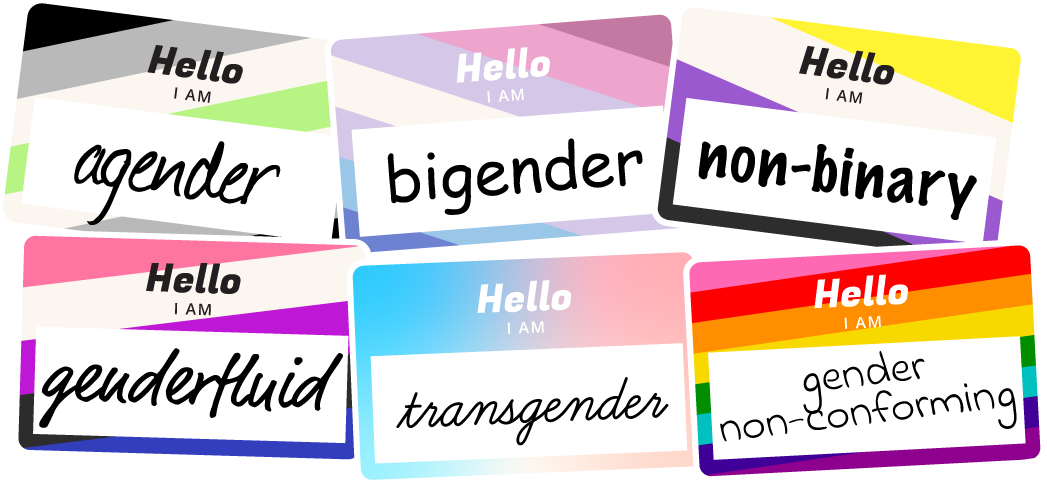
Some gender terminologies
agender (adjective): A term that describes someone who falls under the trans umbrella and does not have a gender identity. Some describe this experience as having a ‘lack of gender’, while others describe themselves as ‘gender-neutral’.
non-binary (adjective): this word is commonly used to describe people who do not identify exclusively as either a man or a woman.
Not all non-binary people experience body dysphoria and choose to transition; they may opt to change their gender expression and adopt a more androgynous presentation.
gender-diverse (adjective): An umbrella term relating to a person whose gender identity or expression does not conform to the cis-binary classification of gender.
demigender (adjective): used to describe people who feel close to a particular gender but does not fully identify with them. Demi- is a Latin prefix meaning half.
Some who identify as demigender may use terms like demiboy or demigirl to describe their gender experience more specifically.
bigender (adjective): A word to describe someone who has two gender identities.
These may be (but are not always) man and woman. Not to be confused with bisexuality — which refers to a sexual attraction between two or more genders. Bigender is considered a non-binary identity.
genderfluid (adjective): used to describe people who experience a fluctuating gender identity. For instance, someone with a typical female body may sometimes be perfectly content with their body and being seen as a woman, but experience periods of gender dysphoria and identifying as another gender. Often classified under non-binary.
gender non-conforming (adjective): a term that denotes a person whose behaviour, appearance and presentation does not conform to cultural or social norms.
People who are gender non-conforming may engage in behaviour like crossdressing, but still identify with the sex they were assigned at birth.
Dysphoria

Dysphoria, or Gender Dysphoria (noun): A state of distress due to the mismatch between the gender one is assigned at birth and the gender one wishes to express.
In instances where a diagnosis is required to obtain gender-affirming healthcare, the distress sometimes has to be deemed clinically significant by a doctor.
A related term is gender incongruence, which refers to this mismatch regardless of whether the person in question feels distress.
Read more about gender dysphoria and incongruence here.
Pronouns
English — the language most people speak here — use she, he, or they as pronouns.
In Mandarin, 他 (he) and 她 (she) (both pronounced tā or ta1) are used; Malay uses the gender-neutral pronoun dia; while Tamil uses அவன் (he) or அவள் (she).

Neopronouns
Some non-binary people do not wish to use they or them as pronouns, and may ask you to use another pronoun to refer to them.
Non-binary experiences are often varied, with some people never really identifying with he, she, or they.
Some instances in the English language include ze/hir or fae/faer. There has also been a push for non-binary pronouns in Mandarin, where the use of TA and X也 have risen in queer online communities.